






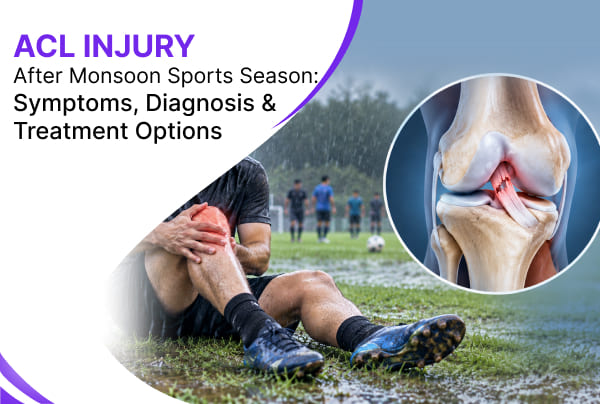
As the monsoon eases and grounds dry out, football turfs, cricket nets, and running tracks fill up again. After weeks of reduced activity, many athletes and weekend players jump straight back into full-intensity sport - and that combination of rust, enthusiasm, and sudden movement can put real stress on the knee. One of the most common injuries seen during this period is damage to the anterior cruciate ligament, or ACL.
This article explains what an ACL injury is, why it tends to show up around sports season, how doctors diagnose it, and what treatment options typically look like - so you know what to expect and when it's time to get your knee checked.
What Is an ACL Injury?
The ACL is one of the main ligaments inside your knee. It connects your thigh bone (femur) to your shin bone (tibia) and helps keep the knee stable, especially during twisting, pivoting, and sudden changes in direction. When this ligament is stretched or torn, it's called an ACL injury.
Not every ACL injury is the same. A sprain means the ligament is stretched but still largely intact. A partial tear means some of the fibers have torn while others remain connected. A complete tear means the ligament has fully ruptured and no longer holds the knee together the way it should. The type and severity of the injury largely decide what treatment path makes sense.
Why ACL Injuries Can Happen During Sports
ACL injuries often happen without any contact at all. A sudden change in direction, a hard stop, an awkward landing after a jump, or a sharp pivot with the foot planted can all put more force on the ligament than it can handle. Contact injuries - like a direct blow to the knee during a tackle - can cause the same damage.
Certain patterns raise the risk further, especially after a break from regular activity:
- Poor landing technique, where the knee caves inward on landing
- Returning to full-intensity sport too quickly after a layoff
- Weak or imbalanced thigh and hip muscles
- Skipping warm-up or conditioning before play
- Fatigue late in a match, when technique tends to slip
If you're getting back into regular play after the monsoon lull, easing into intensity rather than jumping straight into competitive matches can meaningfully lower this risk.
Common ACL Injury Symptoms
Most people remember the moment it happened. Common signs of an ACL injury include:
- A loud pop or snapping sensation at the time of injury
- Sudden, sharp pain in the knee
- Rapid swelling, often within a few hours
- Difficulty putting full weight on the leg
- A feeling that the knee is unstable or "giving way"
- Reduced range of motion in the knee joint
Symptoms can vary depending on whether the injury is a partial or complete tear. Some people can still walk shortly afterward, which sometimes leads to the injury being underestimated. If your knee feels unstable during simple movements like walking or climbing stairs, that's a signal worth taking seriously.
How Is an ACL Injury Diagnosed?
Diagnosis usually starts with understanding how the injury happened and moves through a few possible steps.
- Physical Examination - an orthopedic doctor will check the knee's range of motion, swelling, and stability. Specific movement tests can help indicate whether the ACL has been affected and whether other structures, like the meniscus, may also be involved.
- X-Ray - mainly helps rule out fractures or bone-related injuries. It does not directly show ligament damage, since ligaments don't appear on standard X-ray images.
- MRI Scan - generally the most reliable way to evaluate soft tissues like the ACL, other ligaments, and the meniscus. That said, not every patient with a suspected ACL injury automatically needs an MRI - your doctor will decide based on your symptoms, physical exam findings, and how the injury occurred.
If you've recently hurt your knee and aren't sure whether you need an X-ray, an MRI, or just a physical exam, that's exactly the kind of judgment an orthopedic doctor is trained to make. The team at AJRC – Ashish Joint Replacement Center, Patna, can walk you through the right diagnostic steps for your specific symptoms rather than leaving you to guess.
ACL Injury Treatment Options
Treatment depends on several factors: how severe the tear is, whether it's partial or complete, your age, activity level, sport participation, overall knee stability, and whether other structures were also injured. There isn't a single "right" treatment for every ACL injury - it's a decision made between you and your orthopedic doctor.
Non-Surgical Treatment
For some partial tears or for people with lower activity demands, non-surgical treatment can be appropriate. This typically includes activity modification, rest in the early stage, ice where advised, bracing if recommended, and a structured physical therapy program focused on strengthening the muscles around the knee and restoring stability without relying solely on the ligament.
ACL Reconstruction Surgery
For complete tears, especially in athletes who want to return to pivoting or contact sports, ACL reconstruction may be considered. This is typically performed through arthroscopic surgery, a minimally invasive technique where the torn ligament is reconstructed using a graft. At AJRC, this procedure is performed by Dr. Ashish Singh and his team, who assess each patient's anatomy, activity level, and goals before recommending a surgical plan. Surgery is only one part of the process - a well-followed rehabilitation program afterward plays a major role in how well the knee ultimately recovers and how safely you return to sport. Not every ACL tear requires surgery, and your doctor will help you weigh the options based on your specific case.
Important Reads
- Sports Injury Center - AJRC Patna
- Knee & Shoulder Arthroscopic Surgery - AJRC
- Robotic Knee Replacement Surgery - AJRC Patna
- BMAC (Regenerative) Treatment for Ligament & Joint Injuries - AJRC
- Pain Management Clinic - AJRC Patna
ACL Injury Recovery and Rehabilitation
Whether or not surgery is involved, rehabilitation is central to ACL recovery. The general goals include reducing pain and swelling, gradually restoring range of motion, rebuilding strength in the thigh and hip muscles, working on balance and stability, and slowly reintroducing sport-specific movement.
Recovery timelines vary from person to person based on the injury, treatment approach, and how consistently rehabilitation protocols are followed, so it's best to avoid comparing your timeline to someone else's. Sticking to your physiotherapist's guidance, rather than rushing back to sport, generally leads to better long-term outcomes.
How to Reduce the Risk of ACL Injuries
While no method eliminates risk completely, certain habits can lower the chances of an ACL injury, particularly as sports activity picks back up after a break:
- Warming up properly before every session
- Building strength in the quadriceps, hamstrings, and hip muscles
- Working on balance and core stability
- Practicing correct jumping and landing technique
- Increasing training intensity gradually rather than all at once
- Using proper footwear suited to the playing surface
- Avoiding a sudden jump back to full-intensity sport after inactivity
When Should You See an Orthopedic Doctor?
Not every knee twinge needs urgent attention, but certain signs suggest it's time for a proper evaluation: severe pain, rapid swelling, a popping sensation at the time of injury, difficulty walking, a feeling that the knee is unstable, repeated episodes of the knee giving way, or being unable to continue playing after the injury. At AJRC, cases like these are assessed by Dr. Ashish Singh and his team, who can guide you toward the right diagnostic and treatment path.
Persistent knee pain or instability after a sports injury? Get it evaluated by AJRC - Ashish Joint Replacement Center's sports injury team in Patna, rather than waiting it out.
This article is for general educational purposes and is not a substitute for professional medical advice. Please consult a qualified orthopedic specialist for diagnosis and a treatment plan suited to your specific condition.
Frequently Ask Question?
The most common early signs are a popping sound or sensation at the time of injury, sudden knee pain, swelling that develops within a few hours, and a feeling that the knee is unstable or unable to bear weight.
The ACL has limited capacity to heal on its own because of its location and blood supply. However, some partial tears can be managed without surgery through structured physical therapy and activity modification, depending on the severity of the tear and the person's activity level. This decision should be made with an orthopedic doctor.
No. Not every ACL tear requires surgery. The decision depends on factors like tear severity, knee stability, age, activity level, and whether you plan to return to pivoting or contact sports. Some people manage well with non-surgical treatment.
Diagnosis typically involves a physical examination with specific stability tests, and imaging such as X-ray (to rule out fractures) and MRI (to evaluate the ligament and soft tissues) when needed.
Recovery time varies widely based on the severity of the injury, the treatment approach, and how consistently rehabilitation is followed. Your orthopedic doctor and physiotherapist can give you a more accurate estimate based on your specific case.
Many people do return to sport after ACL reconstruction, but this depends on completing a structured rehabilitation program and getting clearance from your surgeon or physiotherapist based on strength, stability, and functional testing - not just how much time has passed.
If you have severe pain, rapid swelling, a feeling of instability, repeated episodes of your knee giving way, or difficulty walking after a knee injury, it's a good idea to get evaluated by an orthopedic doctor rather than waiting for symptoms to resolve on their own.

