






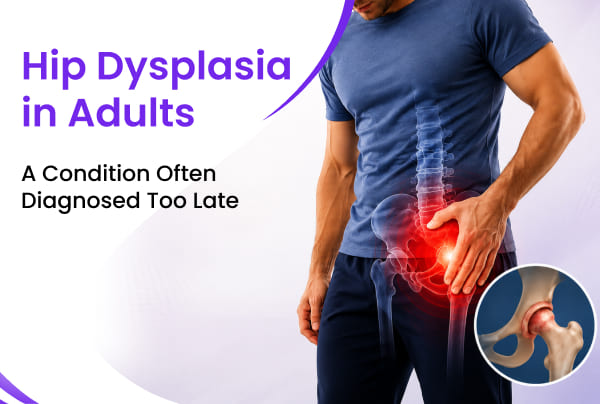
Hip dysplasia in adults is more common than most people realise — and it's frequently missed for years. It happens when the hip socket (acetabulum) doesn't fully cover the ball of the thigh bone (femoral head). The joint may look almost normal in daily life, right up until it starts to hurt.
Most cases begin at birth or in early childhood. But in mild cases, the hip can function reasonably well for two or three decades before pain, stiffness, or a limp finally brings someone to a doctor. By then, many patients have already been told they have "just a muscle strain" or "early arthritis" — without anyone checking the actual shape of the hip socket.
This is exactly why hip dysplasia has earned its reputation as a condition that's diagnosed too late. And a late diagnosis matters, because it narrows your treatment options.
Why Adult Hip Dysplasia Is Diagnosed So Late
There are a few honest reasons this happens:
- The pain is easy to mistake for something else. Groin pain, hip pain, or a dull ache after walking gets blamed on muscle strain, sciatica, or "just getting older."
- Standard X-rays aren't always read for dysplasia. A hip X-ray can look "unremarkable" to a general practitioner unless someone specifically measures the socket's coverage of the femoral head.
- Symptoms come and go for years. Many adults with hip dysplasia manage discomfort with rest and painkillers long before it becomes constant.
- It doesn't fit the usual arthritis picture. Because the person may be in their 20s, 30s, or 40s — an age group doctors don't typically associate with hip joint disease.
Research on adult patients backs this up: many see more than one healthcare provider before dysplasia is correctly identified, sometimes years after symptoms first began. The takeaway isn't to blame anyone — it's to know what to ask for if your hip pain isn't adding up.
Signs and Symptoms You Shouldn't Ignore
Hip dysplasia symptoms in adults can be subtle at first and worsen gradually. Watch for:
- Persistent pain in the groin, or on the side/back of the hip
- A feeling that the hip is "giving way" or unstable during activity
- Clicking, popping, or catching sensations in the hip
- A limp, or a change in the way you walk
- Pain that increases with activity and eases with rest
- Difficulty with prolonged sitting, running, or twisting movements
Having one of these on its own doesn't confirm dysplasia. But two or more together — especially in someone under 50 — is a reasonable signal to get the hip properly imaged, not just examined.
How Doctors Diagnose Hip Dysplasia in Adults
Diagnosis starts with a clinical history and a physical exam, but the confirming step is imaging:
- X-ray of the pelvis — the doctor measures how much of the femoral head is covered by the socket, using what's called the center-edge angle. A shallow socket shows up clearly once someone is looking for it.
- MRI — used when there's a need to check the cartilage and labrum (the cushioning rim of the socket) for early damage.
- Clinical grading — the degree of dysplasia and any existing arthritis is graded, which directly shapes the treatment conversation.
If you've had ongoing hip pain for months with no clear answer, it is reasonable to ask specifically: "Can we check whether my hip socket is properly formed?"
Treatment Options: From Physiotherapy to Surgery
Treatment depends heavily on how much damage has already occurred — which is exactly why early diagnosis changes the options available to you.
Non-surgical management (used when joint damage is minimal):
- Activity and load modification
- Targeted physiotherapy to strengthen hip-stabilising muscles
- Pain management with medication or injections when needed
Surgical management (used when pain persists or damage is progressing):
- Periacetabular osteotomy (PAO): the socket is carefully repositioned to properly cover the femoral head, preserving the person's own joint.
- Hip arthroscopy: used selectively for labral tears associated with dysplasia, though it's not a substitute for correcting the underlying socket shape.
- Total hip replacement (THR): used once significant arthritis has already set in and the natural joint can no longer be preserved.
Structured physiotherapy support plays a role at every stage — before surgery to strengthen supporting muscles, and after surgery to restore full function.
PAO vs Total Hip Replacement: Which One Fits You?
This is the single biggest decision point, and it comes down largely to age and how much cartilage damage already exists:
- Younger patients (generally under 40) with preserved joint space are typically the best candidates for PAO — it relieves pain and can meaningfully delay or prevent arthritis progression.
- Patients around 40–50 fall into a genuine grey zone. Studies comparing the two procedures in this age group show both can offer good pain relief and function; the right call depends on the exact condition of the joint.
- Patients with advanced arthritis, or generally 50 and above, usually do better with total hip replacement, since the joint surface is often too worn for preservation surgery to help.
This is a decision that genuinely needs an in-person assessment with imaging — it isn't something to self-diagnose from an article, including this one.
What Happens If You Leave It Untreated?
Hip dysplasia doesn't stay static. Left unaddressed, it places abnormal stress on the socket rim, which gradually wears down cartilage. Over time, this is one of the leading causes of hip osteoarthritis in people under 60 — arthritis that shows up "early" simply because the underlying socket shape was never corrected.
The earlier it's caught, the more treatment options remain on the table — including joint-preserving surgery instead of total hip replacement.
Why Choose AJRC for Hip Dysplasia Care?
At AJRC (Ashish Joint Replacement Centre), hip dysplasia in adults is evaluated by Dr. Ashish Singh the way it should be — with proper imaging, an honest read of how much joint damage exists, and a clear explanation of every option available, not just surgery. Our approach is built around:
- A thorough, imaging-based diagnosis rather than a symptom-only assessment
- Clear explanation of both joint-preserving and joint-replacement options, matched to your age and joint condition
- Structured rehabilitation and physiotherapy support after any procedure
- A patient-first conversation — we explain trade-offs honestly rather than pushing surgery as the only answer, backed by real patient stories
If your hip pain has been dismissed as "just a strain" for longer than it should have been, it's worth getting the socket itself checked.
Frequently Ask Question?
It's a condition where the hip socket doesn't fully cover the femoral head, causing instability. It usually starts at birth but can stay mild enough to go unnoticed until pain appears in adulthood.
Yes. Mild cases often don't cause symptoms until early adulthood, and the pain is frequently mistaken for muscle strain or general wear and tear, delaying an accurate diagnosis.
Groin or hip pain that worsens with activity, a feeling of hip instability, clicking or catching sensations, and a subtle limp are the most common early signs.
Through a physical exam plus imaging — an X-ray to measure hip socket coverage, and sometimes an MRI to check for cartilage or labral damage.
No, but they're linked. Untreated hip dysplasia is one of the leading causes of early hip arthritis, because the shallow socket wears down cartilage over time.
In mild cases with little joint damage, physiotherapy, activity changes, and pain management can help. More significant dysplasia usually needs a surgical solution.
It's a surgery that repositions the hip socket to properly cover the femoral head, aiming to relieve pain and preserve the patient's natural joint instead of replacing it.
PAO works best under roughly 35–40 years old with minimal arthritis. Past 45–50, or with significant existing arthritis, total hip replacement usually gives better results.
Yes. The abnormal stress on the joint tends to accelerate cartilage wear, often leading to earlier-than-usual hip osteoarthritis.
If groin or hip pain persists for more than a few weeks, especially with instability, clicking, or a limp, it's worth getting properly imaged rather than assuming it's a strain.

