







Knee and hip replacements are among the most successful operations in orthopaedics. For most people, a new joint means less pain and a more active life for many years. Still, an artificial joint is a mechanical part, and sometimes it stops working as it should.
When that happens, a second operation called revision joint replacement may be advised. This guide explains, in simple words, what revision surgery is, why it may be needed, which warning signs to watch for, and what diagnosis, surgery and recovery usually involve. It is written for patients and families in Patna and across Bihar.
What Is Revision Joint Replacement?
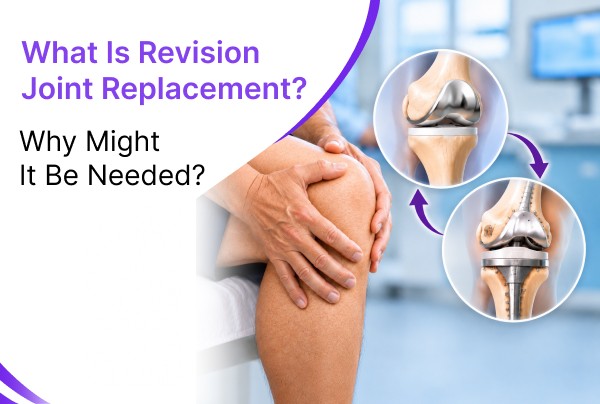
Revision joint replacement is surgery to remove some or all parts of an earlier artificial joint and replace them with new ones. Doctors also call it revision arthroplasty ("arthroplasty" simply means joint replacement surgery).
It is most often done for the knee and hip. Sometimes only one worn part, such as a plastic liner, is changed. In other cases the whole implant is replaced and the weakened bone is rebuilt.
How Is Revision Joint Replacement Different from a First (Primary) Joint Replacement?
The goal of both operations is the same: relieve pain and improve movement. The difference lies in how complex the job is.
- More planning: The surgeon must study the old implant, the bone around it and the reason it failed.
- Removing the old implant: Parts that are cemented or firmly fixed to bone have to be taken out carefully.
- Bone loss: The bone may be thinner or damaged, so special implants with longer stems, metal augments or bone grafts may be used.
- Longer operation and recovery: Revision usually takes more time in theatre, and healing is often slower than after the first surgery.
That is why revision is best handled by a team experienced in complex joint replacement.
Why Might a Knee or Hip Replacement Need Revision Surgery?
The right treatment depends on finding the real cause. These are the most common ones.
Implant Loosening or Wear Over Time
An artificial joint must stay firmly attached to the bone. Over many years, the bond between implant and bone can weaken, and the implant may become loose. The plastic surfaces can also slowly wear down. Tiny wear particles may irritate the body and cause bone loss around the implant, called osteolysis.
Younger and very active patients put more load on the joint and may face wear-related problems sooner.
Infection Around the Artificial Joint
Infection is uncommon, but it is one of the most serious reasons for revision. Bacteria can stick to the surface of the implant soon after surgery or, rarely, years later when germs spread through the blood from another infection in the body.
Antibiotics alone usually cannot clear bacteria that have settled on an implant. Surgery is often needed. Depending on the case, this may be done in one operation, or in two stages: the infected implant is removed, a temporary antibiotic-loaded spacer is placed, and a new joint is fitted once the infection has cleared.
Dislocation or Joint Instability
A replaced hip is a ball-and-socket joint. If the ball slips out of the socket repeatedly, it is called recurrent dislocation. In the knee, weak or unbalanced ligaments can make the joint feel wobbly or "give way". When bracing and physiotherapy are not enough, revision may be needed to correct implant position or use a more stable design.
Fractures Around the Implant (Periprosthetic Fracture)
A periprosthetic fracture is a break in the bone around an artificial joint. Most happen after a fall, and weak bones from osteoporosis increase the risk. Some can be fixed with plates and screws, but if the implant has become loose, revision is usually required.
Persistent Pain, Stiffness or Implant Failure
Some patients continue to have pain or stiffness that does not improve with time and rehabilitation. Causes can include implant position, scar tissue, a worn or broken part, or, rarely, a reaction to metal. Not every painful replaced joint needs surgery, though. Pain can also come from the spine, nerves or nearby tendons, so a careful evaluation comes first.
What Are the Warning Signs That Your Joint Replacement May Be Failing?
See an orthopaedic specialist if you notice:
- New or increasing pain in a joint that had been comfortable
- Pain when you start walking or put weight on the leg
- Swelling, warmth or redness around the joint
- A feeling that the knee or hip is loose, unstable or giving way
- Clicking, grinding or a change in how the joint moves
- Reduced movement or growing stiffness
- A change in leg length or limping
- Fever, chills, or wound drainage, which need urgent medical attention
Some problems, such as early loosening, can show on X-rays before you feel anything. This is one reason regular follow-up visits after joint replacement are useful.
Consult an experienced orthopaedic specialist to understand the possible cause and explore suitable treatment options.
How Is a Failed Joint Replacement Diagnosed?
Before recommending revision, the surgeon must know exactly what has gone wrong.
Medical History and Physical Examination
The doctor will ask when the pain started, what makes it worse, and whether you had wound problems, fever or a fall. Records of your first surgery help greatly. The examination checks walking, swelling, movement, stability and leg length.
X-rays, CT Scans and Other Imaging Tests
X-rays are the first test. Comparing them with older X-rays can show loosening, wear, bone loss, fractures or a change in implant position. A CT scan may be used to check implant alignment and bone quality in detail. In selected cases, an MRI with special settings or a bone scan may be advised.
Blood Tests and Joint Fluid Tests for Infection
Infection must be ruled in or out. Blood tests such as ESR and CRP look for signs of inflammation. If infection is suspected, the doctor may draw a small amount of fluid from the joint with a needle (aspiration) and send it to the laboratory to check for bacteria.
How Is Revision Joint Replacement Surgery Performed?
Every revision is planned individually. In general:
- Anaesthesia: spinal or general anaesthesia is given.
- Opening the joint: the surgeon often uses the earlier scar.
- Removing old parts: loose, worn or infected components are carefully removed while saving as much healthy bone as possible.
- Rebuilding: bone defects may be filled with augments, cones or bone graft.
- Fitting the new implant: revision implants, often with longer stems for stronger fixation, are positioned and checked for stability.
For infection, the surgery may be done in two stages, weeks or months apart.
What Are the Risks of Revision Joint Replacement Surgery?
Revision surgery is generally more demanding than a first replacement, so the risks are somewhat higher. Possible complications include:
- Infection
- Blood clots in the leg (DVT) or lungs
- Bleeding, sometimes needing a blood transfusion
- Stiffness or reduced movement
- Instability or dislocation
- Fracture during or after surgery
- Nerve or blood vessel injury (uncommon)
- The need for further surgery in future
Your surgeon will explain which risks apply to you.
What Is the Recovery Time After Revision Knee or Hip Replacement?
Recovery is usually slower than after the first joint replacement, and it varies a lot from person to person. Most patients start walking with a walker or crutches within a day or two, under the physiotherapist's guidance. Some may be advised to limit weight on the leg for a while, especially if bone was rebuilt.
Physiotherapy is the backbone of recovery. Exercises restore strength, balance and movement over weeks to months. Some swelling and discomfort can continue for several months. Results depend on the reason for revision, your health and how closely you follow rehabilitation.
How Can You Prepare for Revision Joint Replacement Surgery?
Good preparation makes surgery safer:
- Collect records of your first operation, including implant details and old X-rays
- Control diabetes, blood pressure and other health conditions
- Stop smoking and limit alcohol
- Treat any dental, skin or urine infections before surgery
- Share a complete list of your medicines, including blood thinners
- Arrange family support and make your home safe, with a firm chair and no loose rugs
Why Choose AJRC for Revision Joint Replacement Consultation in Patna, India?
At the Ashish Joint Replacement Centre (AJRC) in Kankarbagh, Patna, patients are evaluated by Dr. Ashish Singh, an orthopaedic surgeon whose practice includes primary and revision hip and knee replacement. The focus is on finding the real cause before suggesting any treatment, surgical or not.
AJRC offers knee replacement, hip replacement and joint replacement (arthroplasty) care under one roof, along with a dedicated physiotherapy and rehabilitation centre to support recovery.
Conclusion
Revision joint replacement is a specialised operation that can help when a knee or hip replacement no longer works well. Common reasons include loosening, wear, infection, instability and fractures. Not every painful replaced joint needs another operation, and a careful diagnosis is always the first step.
Early assessment can help identify the cause and determine the appropriate treatment.
Medical disclaimer: This article is for general information only and is not a substitute for professional medical advice, diagnosis or treatment. Every patient is different. Please consult a qualified orthopaedic surgeon about your own condition.
Frequently Asked Questions?
Revision joint replacement is an operation to remove some or all parts of an existing artificial joint and replace them with new parts. It is usually done when a knee or hip replacement becomes loose, worn, infected, unstable or damaged by a fracture, and it aims to reduce pain and restore function.
The most common reasons are implant loosening, wear of the plastic parts, infection, repeated dislocation or instability, and fractures around the implant. Younger, very active patients may wear out a joint sooner. The exact reason must be identified through examination and tests before revision is planned.
Warning signs include new or worsening pain, swelling, warmth, a loose or unstable feeling, clicking, stiffness, limping or a change in leg length. Fever or wound drainage needs urgent care. Only an orthopaedic specialist can confirm failure, using examination, X-rays and sometimes blood or joint fluid tests.
Yes, usually. The surgeon must remove the old implant, manage bone loss and often use special revision implants. The operation tends to take longer and recovery can be slower. Careful planning and an experienced orthopaedic team help manage this added complexity.
Recovery time differs for each person. Most patients begin walking with support soon after surgery, but full recovery often takes several months of regular physiotherapy. The reason for revision, the amount of bone repair needed, and your general health all affect how quickly you recover.
See a specialist if pain returns or increases, the joint feels unstable, swelling persists, or walking becomes harder. Seek urgent care for fever, redness or wound drainage. Regular follow-up visits, even when you feel fine, help detect problems such as loosening at an early stage.

