








Hip pain that doesn't ease with medicines, physiotherapy or lifestyle changes can slowly take over daily life - climbing stairs or walking short distances becomes difficult. For patients with severe osteoarthritis, avascular necrosis or long-standing joint damage, hip replacement is often the option once other treatments haven't helped enough.
Robotic-assisted hip replacement surgery is now available at a growing number of hospitals across India, and patients naturally want to know what it involves before deciding. This article walks through what typically happens before, during and after robotic hip replacement surgery - so you can have an informed conversation with your orthopedic surgeon.
What Is Robotic Hip Replacement?
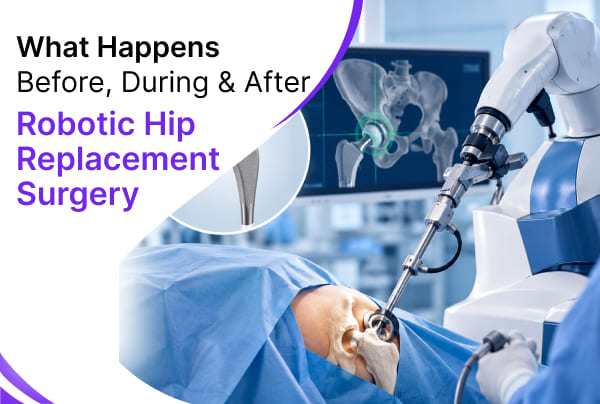
Hip replacement surgery involves removing the damaged parts of the hip joint and replacing them with an artificial implant, restoring movement and reducing pain. Robotic-assisted hip replacement uses a computer-guided system alongside this standard procedure. Imaging builds a 3D model of the patient's hip beforehand, helping the surgeon plan implant size, position and alignment. During the operation, the robotic arm can assist with guiding bone preparation and implant placement based on that plan.
Worth being clear about: the robotic system does not perform surgery on its own. The surgeon makes every clinical decision and physically carries out the procedure - the system is a planning and guidance tool, not a replacement for surgical skill.
When Is Robotic Hip Replacement Recommended?
Hip replacement, robotic or conventional, is usually considered for:
- Severe osteoarthritis of the hip
- Avascular necrosis (AVN), where hip bone tissue loses its blood supply
- Long-standing joint damage from injury or inflammatory arthritis
- Certain hip fractures, particularly in older patients
- Pain and stiffness continuing despite medication, physiotherapy and lifestyle changes
Whether robotic assistance is used depends on individual assessment - anatomy, bone quality, overall health and the surgeon's evaluation - not simply because the technology exists at a hospital.
What Happens Before Robotic Hip Replacement Surgery?
Initial orthopedic consultation. The process usually begins with a detailed consultation. The surgeon reviews your medical history, examines your hip's range of motion, and discusses pain levels and treatments already tried - medication, physiotherapy or injections - to assess whether surgery is appropriate.
Imaging and surgical planning. X-rays are typically the first step in assessing joint damage. For robotic-assisted surgery, a CT scan is often required to build a 3D model of the hip, helping the team plan implant size, positioning and alignment for your anatomy.
Pre-surgery medical evaluation. Patients usually undergo blood tests, an anesthesia fitness assessment, and a review of current medications - particularly blood thinners or diabetes medication, which may need adjustment. Existing conditions are evaluated and stabilized, and you'll receive pre-operative instructions such as fasting guidelines.
Preparing your home and recovery support. Simple home preparation eases early recovery: a raised toilet seat, removing loose rugs, keeping frequently used items within reach, and arranging help from family for the first few days. Planning time off work and transport for follow-ups also helps, especially for patients travelling from outside the city.
What Happens During Robotic Hip Replacement Surgery?
While exact steps vary by hospital and surgeon, robotic-assisted hip replacement generally follows this sequence:
- Anesthesia - spinal or general, based on your health.
- Surgical access - an incision is made to reach the hip joint.
- Removal of damaged joint surfaces - worn bone and cartilage are removed.
- Robotic-assisted guidance - the system helps guide bone preparation within the surgeon's pre-planned model, with the surgeon controlling each movement.
- Implant positioning - new hip components are positioned per the plan.
- Stability check - leg length and range of motion are verified.
- Closure - the incision is closed and dressed.
The procedure typically takes a little longer than conventional surgery, often 20–30 minutes more, mainly due to extra planning and calibration. Throughout, the surgeon remains in control - the system supports precision but doesn't make decisions or operate independently.
Book a consultation with Dr. Ashish Singh and AJRC's orthopedic team for a personalized assessment.
What Happens Immediately After Robotic Hip Replacement?
After surgery, you're moved to a recovery area where the team monitors your vitals as anesthesia wears off, and pain is managed with medication tailored to your needs. Many hospitals now encourage early movement - walking a short distance with support, sometimes the same or next day. A physiotherapist typically begins working with you early, guiding safe use of a walker or crutches.
Hospital stay length varies by patient and hospital protocol. Before discharge, you'll receive instructions on wound care, medication, activity restrictions and follow-up scheduling.
Recovery After Robotic Hip Replacement Surgery
Recovery happens gradually, and the pace varies between patients based on age, health and how closely post-operative advice is followed.
- First few days: Pain management, wound care and short, supported walks.
- First few weeks: Physiotherapy rebuilds strength and mobility, and most patients gradually reduce dependence on walking aids, guided by the surgeon.
- 6 to 12 weeks: Many notice increasing strength, better balance and more independence. A follow-up visit, sometimes with an X-ray, helps confirm healing.
- Longer term: Strengthening continues over several months, with many returning to most routine activities within this period, though this varies. Regular follow-ups help track progress.
Benefits and Limitations of Robotic Assistance
Possible benefits:
- More personalized surgical planning based on the patient's own 3D imaging
- Assistance with precise implant positioning and alignment
- Potentially greater consistency in specific steps of bone preparation
Limitations to keep in mind:
- Not every patient needs, or is suited to, a robotic-assisted approach
- It requires specific hospital technology and surgeon training
- It does not eliminate the general risks of joint replacement surgery
- It does not guarantee a better outcome for every patient
- Surgeon experience and judgment remain the most important factor
Who May Be a Candidate for Robotic Hip Replacement?
Candidacy depends on several factors: diagnosis and extent of joint damage, bone quality, hip anatomy, previous surgeries, overall health, and the surgeon's assessment. Availability of robotic technology at a given hospital is also a factor. Whether robotic-assisted or conventional hip replacement is more appropriate is decided jointly by patient and surgeon after examination - not a default choice for everyone.
Important Reads
- Robotic Joint Replacement Surgery at AJRC
- Robotic Knee Replacement Surgery
- Physiotherapy & Rehabilitation After Joint Surgery
- Understanding Arthritis and Joint Damage
- About Dr. Ashish Singh, Orthopedic Surgeon
Choosing an Orthopedic Hospital and Surgeon in India – AJRC
If you're evaluating where to have hip replacement surgery in India, look beyond robotic technology alone. Consider the surgeon's experience with hip replacement and robotic-assisted procedures specifically, the hospital's infrastructure - imaging, ICU and sterile operating facilities - and the strength of its rehabilitation support. Infection prevention, anesthesia and critical-care backup, implant quality, and transparent communication about costs are worth asking about directly. A structured follow-up system matters too, since recovery continues well after discharge.
Hospitals offering robotic-assisted hip replacement alongside organized rehabilitation - such as AJRC in Patna, led by Dr. Ashish Singh, an orthopedic surgeon with over 25 years of experience in hip and knee joint replacement - are among the options patients across Bihar and other parts of India evaluate.
Questions to Ask Your Orthopedic Surgeon
- Am I a suitable candidate for robotic-assisted hip replacement?
- What are the specific benefits and risks in my case?
- How much experience do you have with this procedure?
- What can I realistically expect during recovery?
- How long is the expected hospital stay, and what follow-up care will I need?
Frequently Ask Question?
A procedure where a robotic system assists the surgeon with planning and guidance during bone preparation and implant placement, using imaging to build a 3D hip model. The surgeon controls the surgery throughout.
A procedure where a robotic system assists the surgeon with planning and guidance during bone preparation and implant placement, using imaging to build a 3D hip model. The surgeon controls the surgery throughout.
Both have strong track records. Robotic assistance may help with planning and positioning but doesn't guarantee a better outcome for every patient - suitability depends on individual assessment.
Both have strong track records. Robotic assistance may help with planning and positioning but doesn't guarantee a better outcome for every patient - suitability depends on individual assessment.
No. It assists with planning and guidance during specific steps; the surgeon makes all decisions and physically performs the operation.
No. It assists with planning and guidance during specific steps; the surgeon makes all decisions and physically performs the operation.
It varies, but robotic-assisted procedures often take somewhat longer than conventional surgery, mainly due to extra planning and calibration.
It varies, but robotic-assisted procedures often take somewhat longer than conventional surgery, mainly due to extra planning and calibration.
Recovery varies. Many begin walking with support within a day or two, with physiotherapy continuing over weeks to months.
Recovery varies. Many begin walking with support within a day or two, with physiotherapy continuing over weeks to months.
Many patients stand and take a few steps within a day, with walking distance gradually increasing under physiotherapy guidance.
Many patients stand and take a few steps within a day, with walking distance gradually increasing under physiotherapy guidance.
Conclusion
Robotic-assisted hip replacement is one option within modern joint replacement care - a surgeon-controlled technology that can assist with planning and implant positioning, not a replacement for surgical expertise. Preparing well before surgery, understanding the procedure, and committing to physiotherapy afterward all play a meaningful role in recovery. If you're dealing with persistent hip pain, contact Dr. Ashish Singh and the AJRC orthopedic team about whether robotic-assisted hip replacement is appropriate for your condition.

