








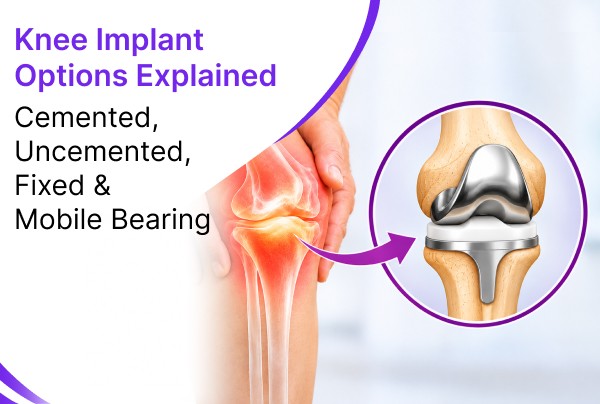
If your surgeon has advised knee replacement, you may have heard the terms cemented, uncemented, fixed bearing and mobile bearing. These describe the main types of knee implants, and they are simpler than they sound. One pair of words tells you how the implant attaches to your bone. The other tells you how its plastic insert sits inside the joint. This guide explains both, what the research shows and how surgeons choose. No single implant suits everyone, which is why Dr Ashish Singh and the team at AJRC, Patna, assess each knee individually.
What Is a Knee Implant in Total Knee Replacement?
A knee implant is an artificial joint that replaces the damaged surfaces of your knee. It is usually considered when severe arthritis causes lasting pain and limits daily movement, and other treatments have stopped helping. You can read more about arthritis surgery at AJRC.
In a total knee replacement, the implant normally has three main parts. Some patients also receive a plastic button behind the kneecap.
- Femoral component: a metal piece fixed to the end of the thigh bone.
- Tibial component: a metal tray fixed to the top of the shin bone.
- Polyethylene insert: a medical-grade plastic spacer between the metal parts, which helps the joint move smoothly.
Implant choice involves two separate questions: how the parts are fixed to the bone, and how the insert behaves. So a knee can be cemented and fixed bearing, or uncemented and mobile bearing, depending on the design.
Types of Knee Implants Used in Knee Replacement Surgery
Cemented Knee Implants: How Do They Work?
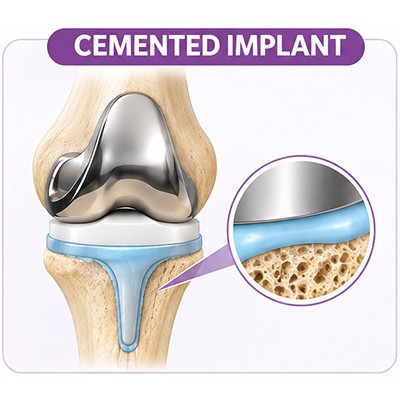
A cemented knee implant is held in place with fast-setting bone cement called polymethylmethacrylate. The cement forms a firm bond between implant and bone during surgery, so fixation does not depend on later bone growth. Cemented fixation has a long track record and is widely regarded as the gold standard. Its main advantages are immediate fixation and suitability for a wide range of patients. Its limitation is that the cement layer can loosen over many years.
Uncemented Knee Implants: What Are Their Benefits?
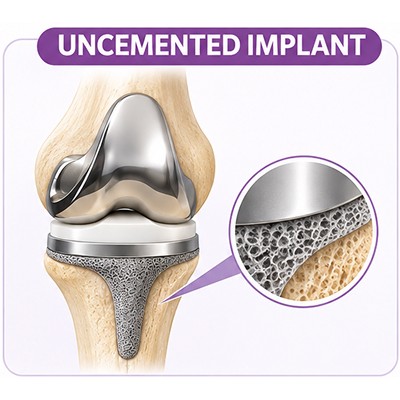
An uncemented, or cementless, implant has a rough or porous surface. It is pressed firmly into prepared bone, and new bone grows into the surface over time. The potential advantage is a lasting biological bond without a cement layer. Its limitation is that it needs bone that can support the implant and grow into it, so bone quality matters greatly. Some implants combine both methods, using cement on one part and no cement on another. This is called hybrid fixation.
Fixed Bearing Knee Implants: Features and Advantages
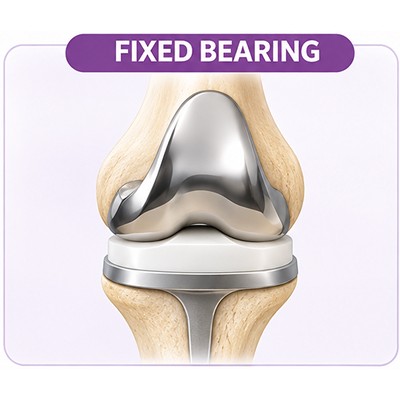
In a fixed bearing knee implant, the plastic insert is locked firmly onto the metal tibial tray. The thigh-bone component then glides over this stationary surface. Most patients receive this design. Its main advantage is simplicity, and it does not rely as heavily on the surrounding soft tissues for stability. Its limitation is that the insert can wear over time, especially under heavy load.
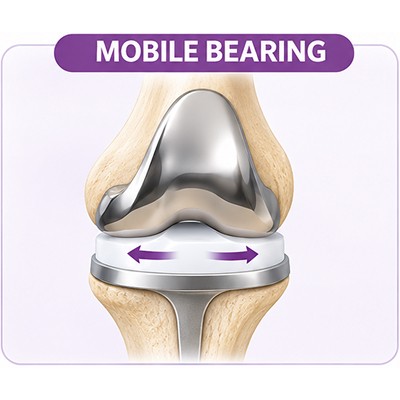
Mobile Bearing Knee Implants: How Are They Different?
In a mobile bearing knee implant, also called a rotating platform, the plastic insert can rotate slightly within the metal tray. The design aims to lower contact stress and move more like a natural knee. However, it needs stronger support from the surrounding ligaments. If that support is weak, there is a higher risk of the insert dislocating.
An orthopaedic specialist can review your X-rays, bone quality and ligament stability, then explain your options clearly.
Cemented vs Uncemented Knee Implants: Key Differences
| Feature | Cemented knee implant | Uncemented knee implant |
|---|---|---|
| How it attaches | Bone cement | Bone growth into a porous surface |
| When fixation forms | During surgery | Initial press-fit, then bone growth over time |
| Bone quality | Can be used across a wide range | Needs bone that can support ingrowth |
| Possible limitation | Cement layer may loosen over time | Relies on successful bone ingrowth |
| Evidence | Long track record | Good results with modern designs; long-term comparison continues |
Fixed Bearing vs Mobile Bearing Knee Implants: Which Is Better?
| Feature | Fixed bearing | Mobile bearing |
|---|---|---|
| Plastic insert | Locked to the tibial tray | Can rotate slightly in the tray |
| Design goal | Stable, simple construction | Lower contact stress, more natural motion |
| Soft-tissue demand | Lower | Higher; needs good ligament support |
| Specific risk | Wear over time | Wear, plus possible insert dislocation |
Neither is better for every patient. A meta-analysis of randomised trials found no difference at short, medium or long-term follow-up, including revision rates and knee scores. A study of trials with about 10 years of follow-up reached a similar view, although one analysis favoured mobile bearing. So the choice usually rests on your knee and your surgeon's assessment, not on the label alone.
How Does an Orthopaedic Surgeon Choose the Right Knee Implant?
There is no universal best implant, so the decision starts with you rather than a product. Your surgeon examines how your knee moves, checks its alignment and ligaments, and reviews your X-rays and medical history. They also ask what you hope to do after surgery, such as walking comfortably or climbing stairs.
Experience matters here. A surgeon who knows how a particular design behaves can judge whether it suits your knee, and can adjust the plan during surgery if the bone or soft tissues differ from what the X-rays suggested. At AJRC, this assessment also informs planning for joint replacement surgery, including robotic knee replacement where it is suitable.
Factors That Affect Knee Implant Selection
- Age: Younger patients may place more demand on an implant over more years, which can make fixation an important discussion. Age alone does not decide it.
- Bone quality: Bone strength helps determine whether cementless fixation is practical.
- Activity level: Your work, daily routine and activity goals affect the load on the joint.
- Weight: Extra body weight adds load and can contribute to faster wear.
- Ligament stability: Weak ligaments may rule out some designs, including mobile bearing implants.
- Overall health: Other medical conditions affect surgical planning and recovery.
- Surgeon experience: Familiarity with an implant system matters alongside the implant itself.
How Long Do Knee Implants Last?
Many knee implants last for decades. A large analysis published in The Lancet estimated from registry data that about 82% of total knee replacements last 25 years. That is an average across many patients, not a promise for one person.
Durability can depend on implant position, weight, activity level, infection and how the plastic insert wears. Worn parts can loosen and cause pain, sometimes requiring revision surgery. Attending follow-up visits and completing physiotherapy and rehabilitation as advised can help you protect your new knee.
When Should You Consult a Knee Replacement Specialist in Patna?
Consider seeing a specialist if knee pain disturbs your sleep, makes walking or stairs difficult, or continues despite medicines and physiotherapy. Increasing stiffness, swelling or a bowing leg also deserve assessment.
You can request an appointment at AJRC.
Frequently Asked Questions?
Cemented implants are fixed to bone with bone cement during surgery. Uncemented implants are pressed into bone and rely on new bone growing into their porous surface over time.
Neither is better for everyone. Large reviews of randomised trials have generally found similar results, so the choice depends on factors such as ligament stability and your surgeon's assessment.
Registry data suggest that about 82% of total knee replacements last 25 years. Individual results vary with implant position, weight, activity, infection and wear.
They can be, if bone quality is suitable. One review reported similar clinical scores at two years in patients over 70, but longer-term evidence is still needed. Your surgeon will assess your bone.
It can influence the plan, but recovery also depends on your health, surgery and rehabilitation. Your surgeon and physiotherapist will advise when and how to increase activity.
The surgeon considers your bone quality, ligament stability, age, activity level, weight and overall health, along with their experience of the design. The choice is made for your individual knee.
Yes. The plastic insert can gradually wear and parts can loosen, which may eventually require revision surgery. Regular follow-up helps detect problems early.
Choosing the Right Knee Implant for You
The types of knee implants differ in how they attach and how they move, but the best choice is always personal.
For guidance based on your own knee, consult Dr Ashish Singh at AJRC or book an appointment online.

